
Legal & Solicitor
Essential Construction Legal and Solicitor advice:
Safeguarding Your Business and Workforce
Construction Legal & Solicitor Services UK
Why Legal Matters in Construction
Legal professionals play a pivotal role in the construction industry. From contract drafting to dispute resolution and compliance, solicitors help keep projects legally sound and commercially viable. In a sector marked by complex regulations, evolving standards, and high-value risks, construction solicitors are indispensable.
This guide outlines the key legal services required in UK construction and how firms can position themselves as essential partners on SPECIFY HUB.
- Construction Contracts
- Planning & Regulatory Advice
- Dispute Resolution & Litigation
- Employment & Subcontracting Law
- Health & Safety Compliance
- Real Estate & Property Development Law
- Insurance & Risk Management
Construction Contracts: Drafting, Reviewing & Negotiation
Robust contracts are the foundation of successful construction projects. Solicitors ensure these documents protect the interests of all parties involved whether they are developers, contractors, subcontractors, suppliers, or consultants. The contract should be specific to the requirements of the project.
Key Contractual Services
– Reviewing standard and non-standard terms. The standard contract terms are: JCT (Joint Contracts Tribunal), NEC (New Engineering Contract), and FIDIC (Federation of Consulting Engineers) contracts. These forms of contract offer efficient and tested clauses that are well-recognised within the construction industry, and comply with current law. Non-standard terms arise from bespoke contracts or amendments to standard contract terms. They may be required for certain types of project, but carry more risk. The Construction Leadership Council (CLC) advises using standard terms and only introducing bespoke clauses when necessary. Find out more from the CLC here.
– Negotiating scope, payment terms, risk allocation, and liabilities. Your solicitor should identify potential liabilities and advise on protective clauses in the contract that reduce your exposure to financial risk and disputes.
– Advising on collateral warranties, performance bonds, and guarantees. If any of these are to be taken out they should be prepared and/or reviewed by your construction solicitors to give projects additional security and reduce the risk of disputes.
Tip for Solicitor Firms:
Showcase your experience with specific contract forms (e.g. NEC4 or JCT Design and Build) on SPECIFY HUB to attract targeted enquiries.
Planning & Regulatory Advice
Planning law in the UK is intricate and frequently updated. Solicitors guide construction clients through planning approvals, environmental assessments, and appeals.
Key Areas of Support:
Advising on planning applications and objections
A solicitor will guide their client through the planning process, assisting with complex applications and appeals, providing strategic advice, negotiating with authorities, and handling potential litigation.
Supporting appeals and public inquiries
A construction company may face an appeal or public inquiry due to major planning disputes, serious accidents causing public concern, allegations of significant administrative or regulatory failure, or complex legal challenges. These can be initiated by the developer, the local authority, or an interested third party.
Assisting with Section 106 Agreements and Community Infrastructure Levies (CIL)
A Section 106 (S106) agreement is a legally binding contract between a local council and a developer, used to mitigate the impact of a development on the local community and infrastructure. It is a planning obligation that can require developers to either provide financial contributions or carry out specific tasks, such as building affordable housing, improving local roads, or funding community facilities, in return for granting planning permission. The CIL is a charge local authorities in England and Wales put on developers for new building projects to fund infrastructure like schools, transport, and community facilities. It does not apply in Northern Ireland. Scotland is working on plans for an infrastructure levy, which are supposed to be implemented by Spring 2026.
Environmental compliance and due diligence
Construction firms should ensure compliance with environmental laws. Environmental due diligence is the process of assessing and managing the firm’s environmental risks and liabilities. Due diligence helps identify potential contamination, regulatory issues, and costs, protecting an organization from future legal and financial problems. Example: A solicitor might help a contractor navigate the restrictions around heritage buildings or protected wildlife zones that could delay ground works.
Dispute Resolution & Litigation
Construction disputes can be costly and disruptive. Whether through adjudication, arbitration, or litigation, legal experts can help resolve issues quickly and fairly. Litigation is the formal court process. Alternative Dispute Resolution (ADR) methods like adjudication are often faster and more cost-effective. Adjudication provides a quick, interim decision that can be enforced. Litigation is typically a last resort due to higher costs and longer timelines but may be necessary for complex cases with multiple parties, and is sometimes the final determination method in contracts.
Common Disputes:
Delays and extensions of time (EOT)
These are a formal process for adjusting a project’s completion date when events beyond the contractor’s control cause delays. An EOT allows the contractor to avoid liability for liquidated damages for the period of the delay by establishing a new, revised completion date. The process requires timely notification and a formal claim, typically based on specific ‘relevant events’ defined in the contract, such as employer-caused variations or unforeseen weather.
Payment disputes under the Housing Grants, Construction and Regeneration Act 1996
Payment disputes under the Housing Grants, Construction and Regeneration Act 1996 (HGCRA) are primarily handled through the right to adjudication, a swift dispute resolution process where an adjudicator makes a temporary, binding decision. The Act also ensures prompt payment by providing the right to interim payments, requiring payment and pay less notices, and prohibiting “pay when paid” clauses. If a contract fails to comply with these provisions, the statutory Scheme for Construction Contracts will be implied into the agreement. Find out more here.
Defective workmanship or design
Defective workmanship refers to flaws in the execution of construction work, for example contractors failing to build according to the documents, leading to issues like uneven surfaces. Defective design involves errors in the plans or specifications. Design defects are errors in the design itself, such as specifying incorrect materials or improperly-sized systems. Lawyers can advise property owners, developers, contractors, and other parties on their rights and options for resolving such disputes.
Termination and breach of contract claims
Termination of a construction contract can occur through agreement, frustration, or breach. A breach allows for termination only if it is a repudiatory breach, a serious violation that goes to the ‘root of the contract.’ Claims arise from a wrongful termination, which can result in damages for loss of profit or, in the case of a valid termination, claims for costs and losses incurred as a result of the other party’s breach.
Dispute Resolution Methods
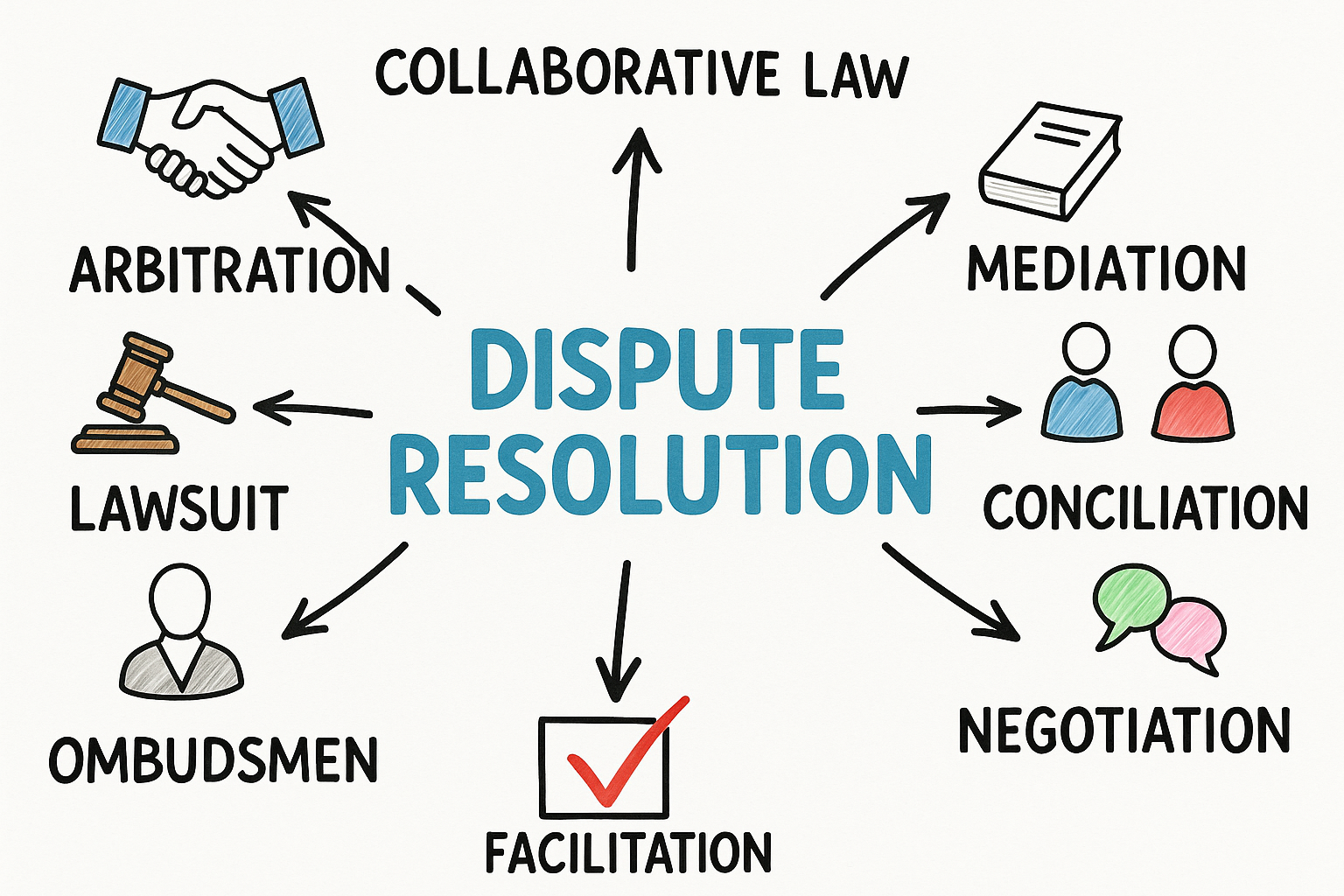
These are the most common forms of legal dispute resolution.
Negotiation: An informal, direct discussion between parties to reach a voluntary, cost-effective agreement.
Adjudication: Often the first step under standard construction contracts. An adjudicator makes a decision, which is often temporarily binding, to quickly resolve the dispute. This is typically within 28 days. This method is widely used in the construction industry to keep projects moving.
Mediation: A confidential and cost-effective resolution method. A mediator helps to facilitate communication and guides parties toward an acceptable solution, but does not make a decision.
Arbitration: A more formal process where an arbitrator hears evidence and issues a final, legally binding decision. This is similar to a private court.
Litigation: This is used for more serious or unresolved cases, particularly in the Technology and Construction Court (TCC). Litigation is formal legal process in which a court resolves the dispute and issues a legally binding judgment. It is typically more time-consuming and expensive than Adjudication or Mediation.
Employment & Subcontracting Law
From direct employees to subcontractors, employment law in construction is often complex due to the layered nature of site teams. Employment and subcontracting law differs based on whether a worker is an employee or an independent contractor (subcontractor), which determines their rights and obligations. Employees have extensive employment rights, such as unfair dismissal, while subcontractors generally do not and are often considered self-employed. However, a worker can be legally classified as an employee despite being labelled as a subcontractor. Employers must identify their workers correctly to avoid legal penalties and make sure that the correct tax is paid.
Legal Services Include:
Drafting employment contracts and consultancy agreements
Employment contracts are for a long-term, integrated role with employee rights and benefits, while consultancy agreements are for temporary, project-based services provided by an independent contractor.
Advising on IR35, CIS and agency worker regulations
IR35 employees are essentially ‘off payroll’ workers who work through an intermediary company, such as a Personal Service Company (PSC). Their working practices are similar to conventional employees. For small firms, their tax and employment status rests with the PSC, and for larger firms a Status Determination Statement (SDS) is required. Find out more here. The Construction Industry Scheme (CIS) is the industry means of collecting tax from subcontractors, see the ‘Money Matters’ toolbox for more detail. The Agency Worker Regulations (AWR) were introduced to make sure that agency workers enjoyed the same basic rights as permanent employees performing a similar role. Find out more here.
Handling Human Resources (HR) disputes, TUPE transfers, or redundancy programmes
Employers must have formal, written disciplinary and grievance procedures and follow the principles of the Acas Code of Practice on Disciplinary and Grievance Procedures. Failure to follow the code can result in an employment tribunal adjusting compensation awards by up to 25%. The Transfer of Undertakings (Protection of Employment) regulations (TUPE) protects an employee’s rights when a business or service is transferred to a new employer. Under the legislation, employees automatically transfer to the new employer on their existing terms and conditions and with their continuity of employment preserved. Redundancy is potentially a legitimate reason for ceasing employment, but has to be carried out in a fair and legal manner. Employers should establish a genuine business case for redundancy, and document all considerations and alternatives explored. They should then plan the process and undertake individual consultations explaining the reasons, selection of personnel, and available alternatives. A collective consultation is required if 20 or more employees are to be made redundant. For such collective redundancies employers must submit an HR1 form to the Redundancy Payments Service before the consultation starts.
Health & Safety Compliance and CDM 2015
Health and Safety Compliance and CDM 2015
The Construction, Design and Management (CDM) Regulations place legal duties on clients, designers and contractors to ensure safety throughout the build. They govern health, safety, and welfare on all construction projects. They apply to every project, from planning to completion, and aim to manage risks by assigning legal duties to specific roles like the client, principal designer, and principal contractor. Compliance ensures projects are planned safely, the right people are appointed, and there is cooperation and communication among all parties. Find out more here.

Compliance reviews and risk mitigation advice
This involves identifying, assessing, and addressing potential legal, financial, and reputational risks associated with regulatory requirements and internal policies and advising on implementing strategies to reduce the likelihood and impact of identified risks.
Legal defence in HSE investigations or enforcement actions
If you receive an enforcement notice or prohibition order from the Health and Safety Executive it can bring your project to a halt, which may have a lasting effect on your business. It’s important to engage a suitable solicitor firm immediately in order to deal with the issue.
Training on directors’ responsibilities under health and safety law
Specialised training on directors’ health and safety responsibilities is available from various providers in the UK, including courses accredited by the Construction Industry Training Board (CITB) and the Institution of Occupational Safety and Health (IOSH). Specialist law firms and safety consultancies also offer bespoke training and CPD for their clients.
Insurance
Specialist solicitors assist in structuring adequate insurance cover for construction risks including public liability, Professional Indemnity (PI), delay-in-start-up (DSU), and latent defects. They also provide expert advice on negotiating contracts, handling insurance disputes, and ensuring regulatory compliance.
Support Includes:
Reviewing and advising on policy coverage
Handling insurer disputes or indemnity claims
Drafting insurance-backed warranties
Real Estate and Property Development Law
Legal professionals also handle the acquisition, disposal and development of land for construction projects. Key areas include land acquisition, financing, zoning, planning, and construction contracts. Property development law specifically deals with the legal challenges of transforming land, from initial planning and obtaining permits to the final sale of the developed property.
Due diligence and title review
Due diligence is a comprehensive investigation into the property’s legal, financial, and physical condition to identify potential risks before a purchase is finalized. A title review is a crucial part of legal due diligence. It confirms ownership and reveals any restrictions or claimsagainst the property.
Drafting land promotion, option, or development agreements
Land promotion, option, or development agreements define the roles of the landowner and developer in the planning, promotion, and sale of land. It is essential to know who controls the planning process, how the initial costs are worked out, and the way in which the land is sold and the profits shared.
Dealing with restrictive covenants or rights of way
A right of way grants the legal right for someone to pass over land for access. A restrictive covenant is a legally binding agreement that stops a property owner from doing something on their land, such as operating a business or carrying out building works.
Negotiating leases, joint ventures, or forward funding deals
A lease is a contract where an owner (lessor) grants a party (lessee) the right to use an asset for a specified period in return for rent or other payments. There can be an option to buy the asset. Leases are commonly used for occupying a space or for a developer to gain control over a site for a fixed period.
A Joint Venture (JV) is where two or more parties agree to collaborate and pool resources such as capital, expertise and land. The JV partners share the risks, costs, and profits. A JV helps the partners to access greater capital, share expertise, mitigate risk, and undertake projects that would be too large or complex for a single firm to manage.
Forward funding is where an investor agrees to purchase a property from a developer before it is completed and funds the construction costs in stages. It provides the developer with a guaranteed exit and all necessary development capital without needing traditional bank financing.
Conclusion: The Value of Construction Solicitor
A specialist construction solicitor is vital to preventing and resolving disputes, managing risk, safeguarding financial, reputational and commercial interests, and ensuring compliance. This helps to keep projects on track, and protect all parties involved.
SPECIFY Tip:
Firms listed on SPECIFY should clearly define their construction specialisms, whether contract law, planning, disputes or compliance. This will help them to stand out in an industry that values expertise and clarity.